
In this post: the eight work questions I met most often, the two axes behind them, and the first five logic chains: satisfaction vs security, changing jobs and self-employment.
Work and Careers · 3 parts
- 1. Questions, security and self-employment (you are here)
- 2. Hours, collocations and two breakdowns
- 3. Top paragraphs, mistakes and practice
✦ In this post

Work is the topic where my marked essays had the widest range of scores: the lowest was 6 (accept a bad situation or try to improve it) and the highest 7.5 (competition or cooperation). Both were discuss-both-views essays and neither set of arguments was difficult. The difference was whether each paragraph stayed on the side it was meant to argue, and whether each reason was pushed through to a result.
The vocabulary for work questions (tenure, remuneration, work–life balance and so on) is already covered in Topic Vocabulary, Part 1. This post digs one level deeper: what work questions are really testing, how to push an argument all the way through, what was good and what needed fixing in the paragraphs I actually wrote, and finally a demonstration paragraph and three practice questions.
1. Eight common work and career questions
| Question (paraphrased) | Common question type | The real issue |
|---|---|---|
| More and more people are starting their own business or freelancing. Why, and what are the disadvantages? (I wrote this one) | Two questions | Freedom vs risk |
| The working week should be shorter and the weekend longer (I wrote this one, Cam19-2) | Agree / Disagree | Efficiency and well-being vs cost and output |
| When your job is unsatisfying or money is short, should you accept it or try to improve things? (I wrote this one, Cam14-1) | Discuss both views | Security vs progress |
| At work, at school and in life, is competition or cooperation better? (I wrote this one, Cam19-1) | Discuss both views | Individual potential vs team results |
| Is job satisfaction more important than job security? | Agree / Disagree | Inner motivation vs financial security |
| Staying with one company for life, or changing jobs often | Discuss both views | Seniority and promotion vs experience and networks |
| Do the advantages of working from home outweigh the disadvantages? | Outweigh | Flexibility vs communication and boundaries |
| Is it reasonable that some professions (such as entertainers and athletes) earn so much? | Agree / Two questions | Market price vs contribution to society |
Behind these eight questions there are really only two main axes. When I write a work essay, I first decide which axis my arguments sit on:
| Axis | One end | The other end | Useful phrases |
|---|---|---|---|
| Money and security | A stable income, seniority, benefits | Freedom, flexibility, a sense of achievement | job security / a steady income ↔ autonomy / a sense of achievement |
| Individual and group | Individual potential, promotion, competition | Teams, belonging, cooperation | reach one’s full potential ↔ a sense of belonging / collective goals |
2. Argument bank: eight logic chains for work questions
A. Satisfaction vs security
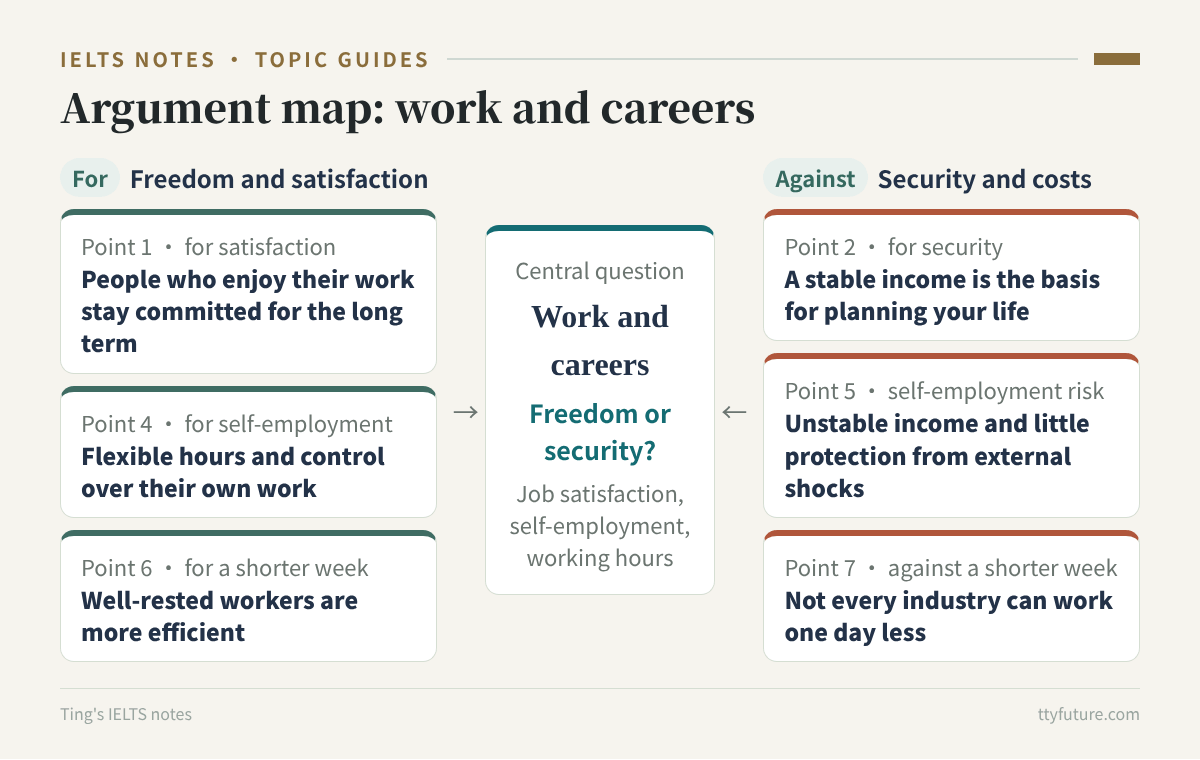
For satisfaction · Point 1: people only stay committed in the long term if they like their work
Point → Job satisfaction is more important than security, because it decides whether a person can do a job well over the long term.
Explanation → A stable but dull job leads people to do the bare minimum. Over time, their performance stays mediocre and their physical and mental health can suffer too. In contrast, people who find their work meaningful are more willing to learn on their own initiative, and once their performance improves, security and promotion tend to follow.
Example → A hypothetical example: two engineers join a company at the same time. One is there only for the security and never touches the subject after work; the other genuinely loves programming and often teaches himself new technologies. Three years later, it is usually the second who is asked to lead a new project.
Employees who find their work meaningful are more willing to improve their skills, and this improvement often brings the security that others seek directly.
For security · Point 2: a stable income is the basis for planning your life
Point → For most people, job security matters more than satisfaction, because planning a life requires a predictable income.
Explanation → Rent or a mortgage, children’s school fees and the cost of caring for older relatives all have to be paid every month. When income is unstable, it is hard to make long-term decisions, and the stress spreads from work to the family. Satisfaction does matter, but it rests on having your basic needs covered.
Example → A hypothetical example: a freelance designer earns a lot one month and has almost no work the next. This kind of swing makes him afraid to apply for a mortgage or to plan to have children.
A stable income allows people to make long-term commitments, such as buying a home or starting a family, which are difficult when earnings fluctuate.
For changing jobs · Point 3: a new environment builds networks and wider experience
Point → The advantage of changing jobs often is that you meet different people and challenges and build broader experience.
Explanation → If you stay at one company, the processes you learn and the people you know are limited to that environment. Moving to a new company means adapting all over again, which is hard, but it forces you to learn new skills and to meet people from different industries, and these become assets for later career moves or promotion.
Example → The opposing side can use seniority: people who stay longer are more likely to become managers, and their pay rises with years of service. In a discuss-both-views essay, these two points contrast neatly.
Changing jobs exposes people to new challenges and new networks, both of which can be valuable assets later in their careers.
B. Self-employment and starting a business
Why people go self-employed · Point 4: flexible hours and control over their work
Point → Many people choose self-employment because they can decide when and how they work.
Explanation → An employee’s schedule is set by the company, so spending more time with family or developing a hobby has to fit around it. Self-employed people can put their work in the hours when they are most productive and choose which projects to take on, and this sense of control is attractive in itself.
Example → In my self-employment essay I wrote that traditional jobs have fixed schedules, while running your own business gives you flexible hours and more time with your family.
Being self-employed allows people to organise their working hours around their families and personal interests, rather than around a fixed company schedule.
The downside of self-employment · Point 5: an unstable income and little resistance to external shocks
Point → The biggest disadvantage of self-employment is risk: the income is unstable, and it is hard to survive external shocks.
Explanation → Employees have a fixed salary, social insurance (in Taiwan, labour and national health insurance) and the company as a buffer. Self-employed people’s income depends on that month’s clients and orders, and if the economy turns down or something unexpected happens, a business without funding or investors to fall back on may simply close.
Example → In my self-employment essay I used COVID-19: during the pandemic, many small and medium-sized businesses could not survive because they lacked funds. Everyone knows this example, and it maps directly onto “external shocks”.
Unlike employees, self-employed people have no regular salary to fall back on, so an external shock such as a pandemic can force them out of business.
Continue reading · Part 2 of 3
IELTS Notes in English · Topic Guides (post 2 of 10)
← Previous: IELTS Task 2 Topic Guide: Education and Learning
Next →: IELTS Task 2 Topic Guide: Technology and Media
Task 1 Structure · Task 2 Structure · Topic Guides · Writing Language · Band Score Samples · Practice Methods · Speaking & Study Tips
✦ Target Your Future
Some days you practise for hours and the score still does not move. I hope these notes remind you that the setbacks are part of the road: every recording you replayed, every essay you rewrote and every sentence you finally dared to say is progress you have already made.
I wrote this down so the next person can take fewer detours. You do not have to follow my method exactly. Find a rhythm that works for you, rest when you need to, and come back for the next small step.
I hope what you take away is more than a number on a score report: a little more confidence in yourself, and the courage to step a bit closer to the world.
— Ting
← Back to IELTS notes in English
Leave a Reply