
這篇筆記:流程圖(process diagram)怎麼寫:被動語態是核心、順序連接詞、自然循環和人工製程的差別、Overview 寫「幾個步驟、從哪裡到哪裡」、名詞化寫法,附我四篇流程圖原文的好句與常見錯誤。
✦ 這篇筆記帶你看
流程圖是我又愛又怕的題型。愛它,是因為它沒有數字可以讀錯,結構也最固定;怕它,是因為我四篇流程圖裡有兩篇 TA 只拿到 5 分:泡麵製程(Task 13)和製磚(Task 26),總分都是 6.5。另外兩篇寶特瓶回收(Task 9)和生質乙醇(Task 37)則拿到 7 分,乙醇那篇的 GRA 還有 8。
同一個人寫同一種題型,差這麼多,原因不是英文突然變好或變差,而是三件事:步驟有沒有漏、被動語態有沒有用對、每一步有沒有說清楚「發生了什麼」。這篇就照這三件事來拆。
好消息是,流程圖是最容易「穩定拿 7」的題型。它不需要估數字、不需要挑重點,只要每一步都寫到、文法用對,TA 和 GRA 就有基本盤。如果你的小作文常常在 6 和 7 之間擺盪,流程圖值得優先練熟,把它變成考場上的「安全牌」。
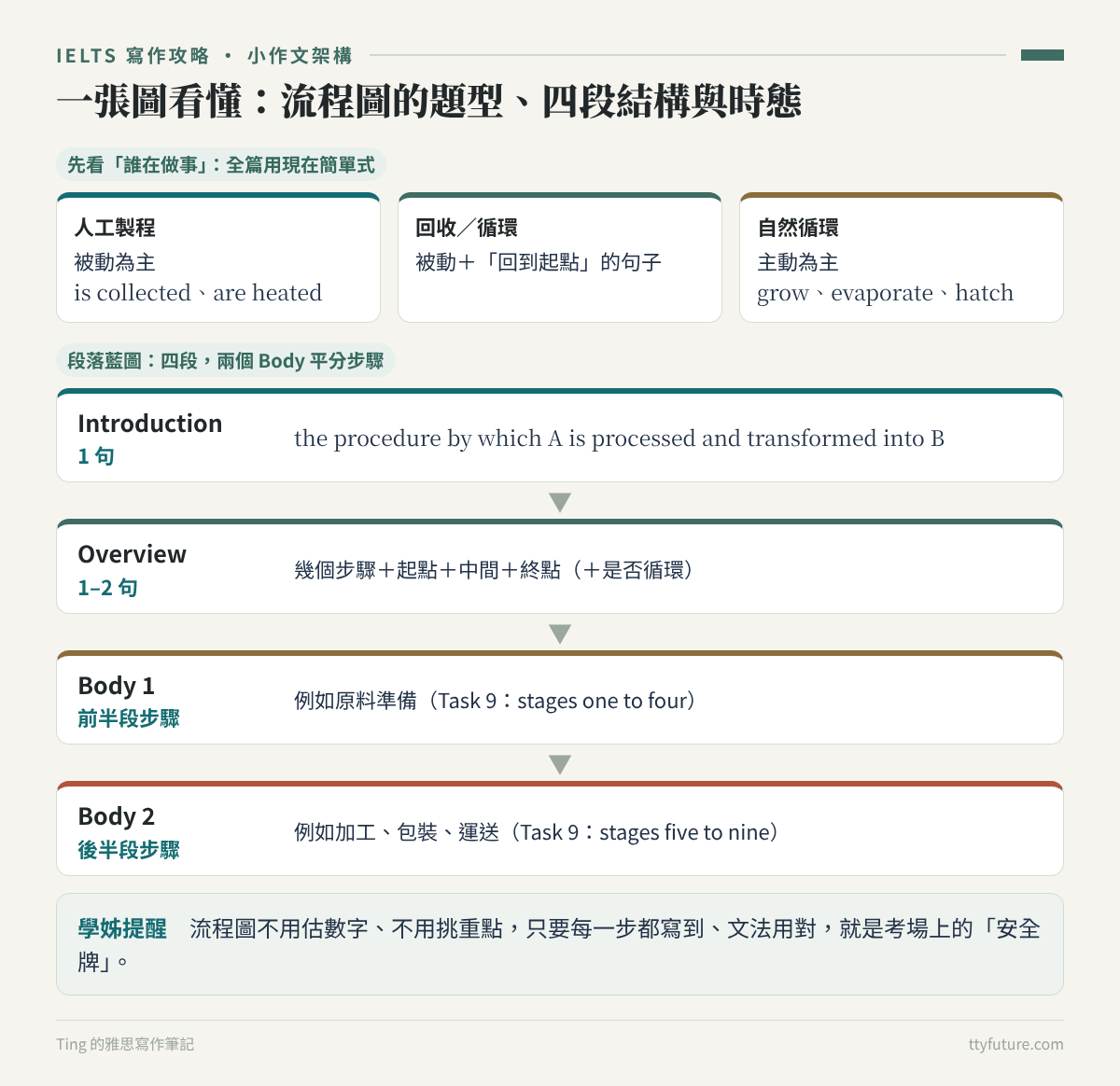
一、題型辨識:人工製程 vs 自然循環
流程圖有兩大類,判斷方法是看「誰在做事」:
| 類型 | 特徵 | 主要動詞形式 | 我寫過的例子 |
|---|---|---|---|
| 人工製程 | 工廠、機器、人在處理某個東西,有起點和成品 | 被動語態為主:is collected、are heated | 泡麵製程(Task 13)、製磚(Task 26) |
| 回收/循環製程 | 人工製程,但最後一步回到第一步 | 被動語態+「回到起點」的句子 | 寶特瓶回收(Task 9) |
| 自然循環 | 生物、天氣、生命週期,沒有人在操作 | 主動語態為主:grow、evaporate、hatch | 生質乙醇(Task 37)前半段的植物生長 |
| 混合型 | 前面自然生長、後面人工加工 | 主動被動都有,要分清楚 | 生質乙醇(Task 37):植物生長→收割→加工→燃燒→二氧化碳回到空氣 |
四篇對照:為什麼兩篇 7 分、兩篇 6.5
| 篇目 | 小分(TA/CC/LR/GRA) | 我自己看到的差別 |
|---|---|---|
| Task 9 寶特瓶回收 | 7/7–8/7/7 | 九個步驟都有寫、最後有交代回到起點;文法錯誤多(are been、trunk、watched),但不影響理解 |
| Task 13 泡麵製程 | 5/7/7/7 | Overview 很完整,但第八步封口沒寫、第七步用 In this stage 帶過,步驟交代不完整 |
| Task 26 製磚 | 5/7–8/7/7 | 第二個 Body 很好,但第一個 Body 加了圖上沒有的意思,前三步描述不精確 |
| Task 37 生質乙醇 | 7–8/7/7/8 | 自然生長用主動、加工用被動,分得很清楚;循環也有寫到 |
四篇的 CC、LR 幾乎一樣,差別全在 TA。TA 5 的兩篇,問題都是「步驟的內容」:一篇漏寫、一篇亂寫。寶特瓶那篇文法錯得比泡麵那篇還多,TA 反而拿 7,因為每一步都交代到了。這給我一個很清楚的優先順序:流程圖先求完整、再求正確、最後才求漂亮。
二、段落藍圖:四段,兩個 Body 平分步驟
| 段落 | 內容 | Ting 原文開頭 |
|---|---|---|
| Introduction | 改寫題目:the procedure by which A is processed and transformed into B | The given picture illustrates the procedure by which plastic bottles are recycled and transformed into a variety of products.(Task 9) |
| Overview | 幾個步驟+起點+中間+終點(+是否循環) | Overall, the process includes nine stages, beginning with the collection of used bottles, going through the preparation of raw materials, and culminating in the production of several items.(Task 9) |
| Body 1 | 前半段步驟(例如原料準備) | Regarding stages one to four, in the first stage, …(Task 9) |
| Body 2 | 後半段步驟(例如加工、包裝、運送) | As regards stages five to nine, …(Task 9) |
Introduction 的三種說法
流程圖的第一句幾乎都可以用同一個骨架,只要換主角。我四篇用的都是 the procedure by which A is processed and transformed into B,好處是穩定,缺點是遇到「循環」或「自然生長」時會怪怪的(植物不是被 processed)。所以我建議準備三種:
| 情境 | 骨架(示範) |
|---|---|
| 人工製程 | The diagram illustrates the process by which clay is turned into bricks for the building industry. |
| 回收/循環 | The diagram shows how plastic bottles are recycled and made into new products. |
| 自然循環 | The diagram illustrates the life cycle of a salmon, from egg to adult fish. |
第二種用 how+子句,是最不容易出錯的寫法;第三種的 from … to … 直接把起點和終點放進第一句,Overview 就可以專心講階段數和循環。
Body 怎麼切?最簡單的方法是步驟數平分,例如九個步驟切成 1–4 和 5–9。更好的方法是依「階段」切,例如「原料準備」和「生產與包裝」,段落第一句就可以寫主題句:The first four stages involve collecting and preparing the bottles.(示範)。我當時常用 Regarding stages one to four 這種開頭,功能上沒問題,但少了「這一段在做什麼」的資訊。
三、核心文法:被動語態
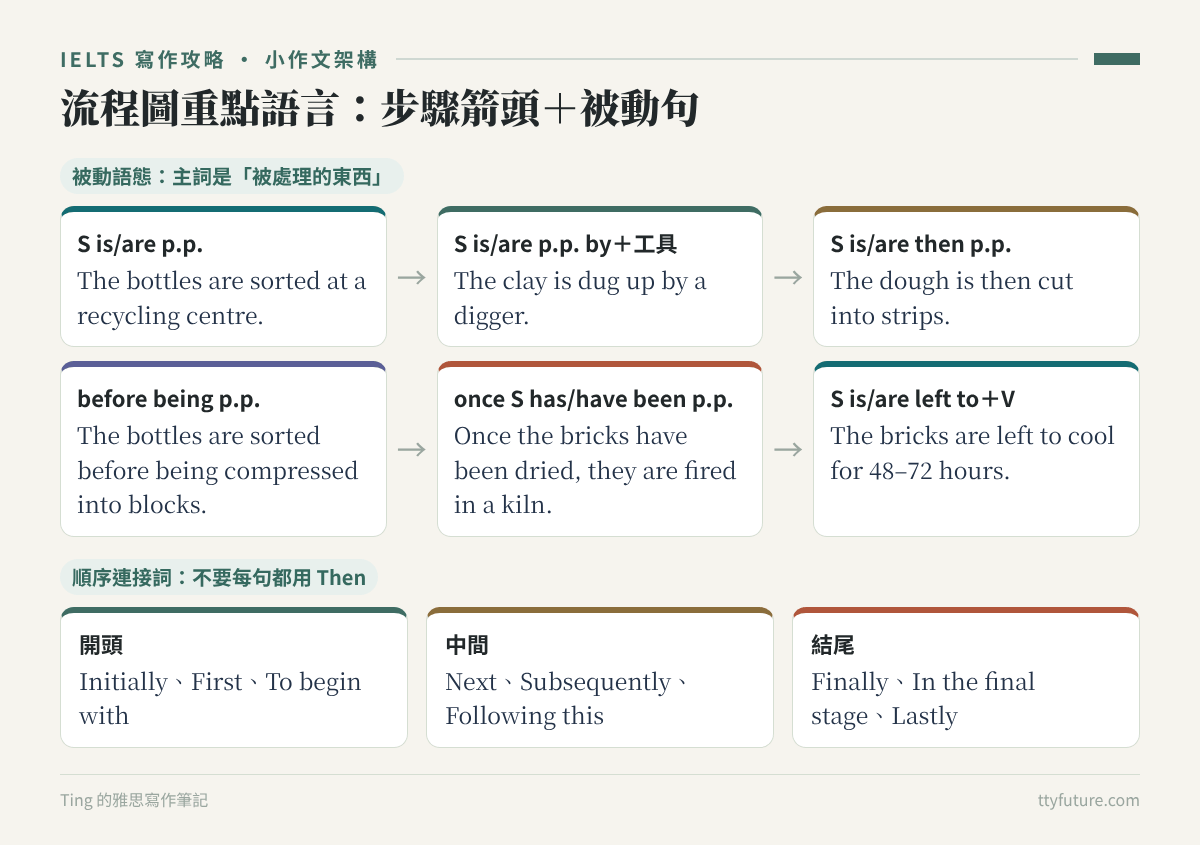
人工製程的主角是「被處理的東西」,不是機器或工人,所以句子主詞是瓶子、黏土、麵團,動詞用被動。基本公式只有一個:主詞+is/are+過去分詞。但實際寫的時候,會需要幾種變化:
| 句型 | 用途 | 示範 |
|---|---|---|
| S is/are p.p. | 最基本 | The bottles are sorted at a recycling centre. |
| S is/are p.p. by+工具 | 需要交代用什麼做 | The clay is dug up by a digger. |
| S is/are then p.p. | 接續上一步 | The dough is then cut into strips. |
| after being p.p. | 把兩步併成一句 | After being washed, the plastic pieces are melted into pellets. |
| before being p.p. | 把兩步併成一句 | The bottles are sorted before being compressed into blocks. |
| once S has/have been p.p. | 前一步完成後 | Once the bricks have been dried, they are fired in a kiln. |
| …, after which S is/are p.p. | 長句連接 | The flour is mixed with water and oil, after which it is rolled into sheets. |
| S is/are left to+V | 等待、靜置 | The bricks are left to cool for 48–72 hours. |
Ting 原文:被動語態的常見錯誤
→ 改法 Once the bottles have been compressed, they are crushed by a special machine …
(Task 9)are been 不是英文。被動是 are+p.p.(are crushed),完成被動是 have been+p.p.(have been compressed)。
✗ 原文 Those bottles are sorted in the recycling center before compressing into blocks.
→ 改法 The bottles are sorted at the recycling centre before being compressed into blocks.
(Task 9)瓶子不會自己壓縮,before 後面也要用被動:before being p.p.。
✗ 原文 … raw material are made, which are used to making a wide range of products …
→ 改法 … raw material is produced, which is used to make a wide range of products …
(Task 9)be used to+V 是「被用來做」;be used to+Ving 是「習慣於」,意思完全不同。
✗ 原文 The given picture illustrates the procedure by which the plants and tree are processed the transformed into ethanol …
→ 改法 The diagram illustrates the process by which plants and trees are processed and transformed into ethanol …
(Task 37)the 應為 and;plants and trees 前後要一致用複數。
四、主動被動混用:什麼時候用主動
被動是流程圖的核心,但不代表每句都要被動。自然界自己發生的事(植物生長、水蒸發、蛋孵化),沒有「被誰做」,就用主動;人或機器處理的步驟才用被動。混用的問題不在「同一篇有主動有被動」,而在「同一個步驟該被動卻寫成主動」。
(Task 37)植物自己生長,用主動 grow 是對的。小修:with the help of。
✗ 原文 Next, by adding sand and water, the third step turns raw material into bricks by moulds or wire cutters.
→ 改法 Next, sand and water are added, and the mixture is shaped into bricks using either a mould or a wire cutter.
(Task 26)主詞變成 the third step,而 by adding 的動作者其實不是 step,這叫懸垂結構。改回被動,主詞是材料本身就清楚了。
✗ 原文 Successfully going through grids and being placed on specific rollers, the raw materials are made.
→ 改法 The clay is then passed through a metal grid onto a roller.
(Task 26)圖上這一步只是黏土經過金屬網和滾輪,並沒有「做出原料」;successfully 是自己加的意思。描述要忠於圖。
自然循環的主動動詞
自然循環題(例如植物生長、動物生命週期、水循環)在劍橋題目裡也常出現。這類題目主詞是生物或自然物,動詞多半是不及物動詞,本來就不能變被動。我整理了一張常用表:
| 階段 | 主動動詞 | 示範 |
|---|---|---|
| 出生、開始 | hatch、emerge、germinate | The eggs hatch into larvae after two weeks. |
| 成長 | grow、develop、mature | The young fish mature over a period of several months. |
| 移動 | migrate、travel、flow | The adult salmon migrate back to the river. |
| 變化 | evaporate、condense、turn into | Water evaporates and later condenses into clouds. |
| 結束、重來 | die、return、begin again | The cycle then begins again. |
以上都是示範句。乙醇那篇是混合型:植物生長是自然的(主動),收割、前處理、加工、加入微生物是人工的(被動),汽車、卡車、飛機燃燒乙醇排放二氧化碳又回到空氣中(主動)。我那篇 GRA 拿到 8,很大一部分原因是這些主被動切換都沒有出錯。
五、順序連接詞:讓步驟一步接一步
流程圖的 CC 很依賴連接詞,但最怕的是每句都用 Then 開頭,或每句都用 In the X stage。建議準備三組詞,輪流使用:
| 位置 | 連接詞 | 注意 |
|---|---|---|
| 開頭 | Initially、First、To begin with、In the first stage | Initially 和 first 不要同一句一起用 |
| 中間 | Next、Then、Subsequently、Following this、After that、At the next stage | Following this 後面接逗號+完整句 |
| 併句 | …, after which …/before being p.p./once … have been p.p. | 兩個短步驟可以合成一句 |
| 結尾 | Finally、In the final stage、Lastly | 最後一步後可以加 completing the production of … |
| 循環 | …, whereupon the cycle begins again/… and the process starts again | 只有圖上真的有回到起點的箭頭才寫 |
以泡麵那篇為例,第二個 Body 四句話裡,出現了 in the sixth stage、after the cooking and drying stage、in this stage 三個 stage,讀起來很像清單。改法不是把 stage 換成 step 或 phase 這種同義字就好,而是讓句子用「動作」來銜接:煮好、炸乾之後放進杯子,接著加入配料,最後貼標籤封口。用 after which、then、finally 串起來,讀者自然知道順序,不需要一直被提醒「現在是第幾步」。
另一個常見問題是連接詞和句子內容不搭。Following this 表示「緊接在上一步之後」,如果中間其實還隔了一步,就會讓讀者以為你漏寫了。寫完後回頭看每個連接詞前後的兩個步驟,在圖上是不是真的相鄰。
(Task 13)用分詞 completing … 收尾,很漂亮。但這一步是 labelling and sealing,封口沒寫到;outside-part 也不是英文,寫 the cups are labelled and sealed 就好。
✗ 原文 In the first three steps, clay is first collected by diggers under the ground …
→ 改法 In the first stage, clay is dug from the ground by a digger …
(Task 26)In the first three steps 和 first 重複;collect 也不太貼切,挖土用 dig。
六、Overview:幾個步驟、起點、終點
流程圖的 Overview 是最好寫的,因為有固定公式:總共幾個步驟+從哪裡開始+經過什麼+到哪裡結束,循環的話再加一句「然後重新開始」。我四篇的 Overview 幾乎都照這個公式,也都沒有大問題:
Overall, the process consists of / comprises [數字] stages, beginning with the [名詞] of …, moving through the [名詞] of …, and culminating in the [名詞] of …
✓ 好句 Overall, the whole process comprises eight stages, beginning with the collection of raw materials, moving through the production of noodles, and culminating in the packaging of the final products.
(Task 13)公式套得很完整。
✗ 原文 … and culminating in the releasing of carbon dioxide, in which the new process begins.
→ 改法 … and ending with the release of carbon dioxide, whereupon the cycle begins again.
(Task 37)名詞化要用真正的名詞 release,不是動名詞 releasing;in which 改成 whereupon 或 after which。
七、名詞化寫法:the collection of …
Overview 公式裡的 beginning with the ___ of …,空格要填「名詞」。這是流程圖最有效的 LR 加分點,也是我筆記裡專門整理過的一張表:
| 動詞 | 名詞化 | 常見錯誤 |
|---|---|---|
| collect | the collection of | — |
| produce | the production of | — |
| prepare | the preparation of | — |
| deliver | the delivery of | the delivering of(Task 26) |
| release | the release of | the releasing of(Task 37) |
| package | the packaging of | — |
| sort | the sorting of | — |
| heat | the heating of | — |
| transport | the transportation of | — |
| distribute | the distribution of | — |
| inspect | the inspection of | — |
有專屬名詞的動詞(deliver → delivery、release → release、produce → production)一定用專屬名詞;沒有的(sort、heat、clean)才用 -ing 形式。
名詞化不只用在 Overview,Body 也可以用來變換句型。例如 The final stage is the packaging and delivery of the bricks.(示範)用「階段=名詞」的句子當段落結尾,比又一個被動句更有變化。另一種常見寫法是 The process begins with the collection of …,把 Overview 公式拆成一句一句,用在 Body 第一句也很自然。
名詞化的好處是讓文章看起來更「學術」,但不要過度。一整段都是 the … of …,讀起來會很僵硬。建議的比例是:Overview 一定用、每個 Body 最多用一次,其他句子回到最簡單的被動句。
要不要「腦補」?忠於圖,但可以說明目的
我的流程圖筆記裡有一句:「流動過程之中要解釋(適時腦補)」。意思是,圖上只寫了 Crushing,你可以寫 the blocks are crushed into small pieces,把「壓碎成小塊」講清楚;圖上寫 Washing,可以寫 the pieces are washed to remove dirt,補一個合理的目的。這種補充讓讀者更容易理解,也讓句子不只是在抄標籤。
但「說明目的」和「自己加事實」是兩回事。製磚那篇我寫 the raw materials are made,圖上根本沒有這件事,這就是加錯了。我自己的界線是:只補「顯而易見的目的或結果」,不補「圖上沒有的步驟或物品」。不確定的時候,寧可只寫圖上的資訊。
八、流程圖詞彙表
| 類別 | 詞彙 |
|---|---|
| 設備 | a designated machine、specialised equipment、a conveyor belt、a kiln、a mould、a silo、a container |
| 處理動詞 | crush、grind、compress、melt、heat、cool、dry、mix、cut、shape、filter、purify |
| 移動動詞 | transport、transfer、deliver、pour、load、carry、pass through |
| 加入 | be added to、be mixed with、be combined with |
| 結果 | be turned into、be transformed into、be made into、form |
| 成品 | raw materials、end products、finished products、final products、packaged items |
| 時間溫度 | for 24 to 48 hours、at a temperature of 870–1,300°C、over a period of 12 months |
九、改寫示範:製磚 Body 1
製磚(Task 26)的 TA 只有 5,我認為主要問題是第一個 Body 對前三個步驟的描述不精確:自己加了圖上沒有的意思(raw materials are made、successfully),又用懸垂結構讓主詞錯位。下面是原文和改寫示範:
In the first three steps, clay is first collected by diggers under the ground, after which clay is put into metal grids. Successfully going through grids and being placed on specific rollers, the raw materials are made. Next, by adding sand and water, the third step turns raw material into bricks by moulds or wire cutters.
The first stage involves digging clay from the ground using a digger. The clay is then placed on a metal grid and passed onto a roller. After that, sand and water are added, and the mixture is shaped into bricks, either in a mould or with a wire cutter.
- 主詞統一是 clay/mixture,全部用被動或 involves+Ving,不再讓 the third step 當動作者。
- 刪掉 successfully、raw materials are made:圖上沒有這些資訊。
- either … or … 交代兩種成形方式,對應圖上的 or。
- 語氣更短更直接,省下的字數可以留給後面的溫度和時間。
這篇第二個 Body 其實寫得不錯:烘乾 24–48 小時、中溫窯 200–980°C、高溫窯 870–1,300°C、冷卻 48–72 小時,數字都有。只是 kiln 拼成 kin、the delivering 要改成 the delivery,最後一句 the final products are packaged and delivered to the market 則是完全正確的被動句。
改寫示範:泡麵 Body 2
As regards the remaining stages, in the sixth stage, noodles discs are cooked with oil and dried by heat. After the cooking and drying stage, those dry discs are put into cups by particular machine. In this stage, ingredients like vegetables and spices are added into those containers. Finally, the labels are put on the outside-part of those cups, completing the production of instant noodles.
The remaining three stages turn the discs into the final product. The noodle discs are first cooked in oil and dried, after which they are placed into cups. Vegetables and spices are then added, and finally the cups are labelled and sealed, ready for sale.
- 主題句先交代這段在做什麼(最後三步把麵餅變成成品),讀者不用自己數。
- In this stage 改成 then:原文的 this 不知道指哪一步。
- 補上 sealed:第八步的封口原文沒寫,這是 TA 被扣的關鍵之一。
- by particular machine 刪掉:缺冠詞,而且不是重要資訊。
十、常見扣分點
| 扣分點 | 影響哪一項 | 我的例子 |
|---|---|---|
| 漏步驟 | TA | Task 13 第八步的 sealing 沒寫 |
| 加入圖上沒有的資訊 | TA | Task 26 successfully、raw materials are made |
| 步驟編號講不清楚 | TA/CC | Task 13 第七步用 In this stage 帶過;Task 37 說十步但 Body 數不起來 |
| are been、being 用錯 | GRA | Task 9 are been compressed |
| 主動被動錯置 | GRA | Task 9 before compressing;Task 26 the third step turns … |
| 未來式 | GRA | Task 9 are going to be washed |
| 動名詞取代名詞 | LR | Task 26 the delivering of;Task 37 the releasing of |
| 拼字 | LR | floor(flour)、trunk(truck)、kin(kiln)、stationary(stationery)、watched(washed) |
拼字那一行看起來很好笑,但都是我真的寫過的。flour/floor、stationery/stationary 這種「拼錯了還是英文單字」的錯誤,電腦拼字檢查抓不到,自己檢查時也很容易略過,在流程圖裡卻特別常出現,因為流程圖常常要用到平常不熟的名詞。
十一、流程圖常見問題
Q1:要不要在文章裡寫 stage one、stage two?可以偶爾寫,幫讀者定位,但不要每句都用。我泡麵那篇寫了 In the fourth stage、in the sixth stage、In this stage,結果第七步反而只用 In this stage 帶過,讀者不知道 this 指的是哪一步。比較好的方式是用連接詞串起來,只在段落開頭交代「這段是第幾步到第幾步」。
Q2:步驟很少,字數不夠 150 怎麼辦?把每一步的「工具、時間、溫度、目的」都寫進去,例如 The bricks are left in a drying oven for 24 to 48 hours.(示範)。不要為了湊字數寫結論或評論,流程圖不需要你的意見。
Q3:by 後面一定要寫動作者嗎?不用。被動句的好處就是可以省略不重要的動作者。The bottles are collected 就夠了,不需要寫 by workers。只有當工具本身是重點時才寫,例如 by a digger、using a wire cutter。
Q4:圖上的標籤可以直接抄嗎?可以用標籤裡的名詞(kiln、silo、cellulose),這些是專有名詞,沒有替代字。但標籤通常是名詞片語(Compressing into blocks),要改寫成完整的被動句(the bottles are compressed into blocks),不能直接把標籤串起來當句子。
十二、流程圖的 20 分鐘流程
| 時間 | 要做的事 |
|---|---|
| 0–3 分 | 數步驟、找起點和終點、確認有沒有循環;判斷哪些步驟是自然(主動)、哪些是人工(被動);決定 Body 從第幾步切開 |
| 3–6 分 | Introduction(the process by which …)+Overview 公式 |
| 6–16 分 | Body 1、Body 2:每個步驟至少一個動詞,圖上有的時間、溫度、工具都寫;短步驟用 after being/before being 合併 |
| 16–20 分 | 對照圖逐步打勾,確認沒有漏;檢查被動語態、時態、拼字 |
練流程圖還有一個好處:題目數量有限,劍橋真題裡的流程圖大概就那些類型(製造、回收、自然循環、能源)。建議大家每種類型至少寫一篇,寫完後拿圖逐步打勾,確認每一步都有對應的句子。回頭比較四篇之後,這個「打勾」的動作是我最想送給當時自己的建議:兩篇 TA 5 的問題,只要逐步對照一次圖就能發現。
十三、寫完檢查清單
- ☐ Overview 有步驟數、起點、終點?循環題有寫「重新開始」?
- ☐ Overview 的步驟數和 Body 對得上?
- ☐ 圖上每一個步驟都有寫到(逐一打勾)?
- ☐ 沒有加入圖上沒有的資訊?
- ☐ 人工步驟用被動(is/are+p.p.),自然步驟用主動?
- ☐ 沒有 are been、is been 這種錯誤?
- ☐ 全篇現在簡單式,沒有 will、are going to?
- ☐ 連接詞有變化,沒有每句都用 Then 或 In the X stage?
- ☐ 名詞化用專屬名詞(delivery、release、production)?
- ☐ 機器、原料名稱拼字正確?
十四、小練習:改成被動語態
2. A machine cuts the dough into strips.
3. They heat the pellets to form raw material.
4. After they dry the bricks, they put them into a kiln.
參考答案:1. The used bottles are collected from households. 2. The dough is cut into strips by a machine. 3. The pellets are heated to form raw material. 4. After being dried, the bricks are put into a kiln.(或 Once the bricks have been dried, they are fired in a kiln.)注意第 1、3 題的 workers、they 是不重要的動作者,被動句直接省略。
延伸閱讀
IELTS 寫作攻略導覽 · 小作文架構(第 5 / 7 篇)
← 上一篇:靜態圖怎麼寫?比例用語、比較句與 respectively 用法
下一篇 →:地圖題怎麼寫?時態判斷、改變動詞與方位詞
✦ Target Your Future
有些日子,明明練了很久,成績卻還停在原地。希望這篇筆記能讓你知道,備考路上遇到挫折並不孤單。一次次重聽的錄音、改過的作文、終於敢說出口的句子,都是你已經走過的路。
把這些經驗寫下來,是想陪下一個正在準備的人少繞一點路。你不必照著我的方法前進,只需要慢慢找到適合自己的節奏。累的時候可以休息,再回來做今天能完成的一小步。
願你最後帶走的,不只是成績單上的數字,還有更相信自己、敢往世界走近一點的勇氣。
— Ting
← 回到 IELTS 備考筆記
Leave a Reply